The Ten Commandments

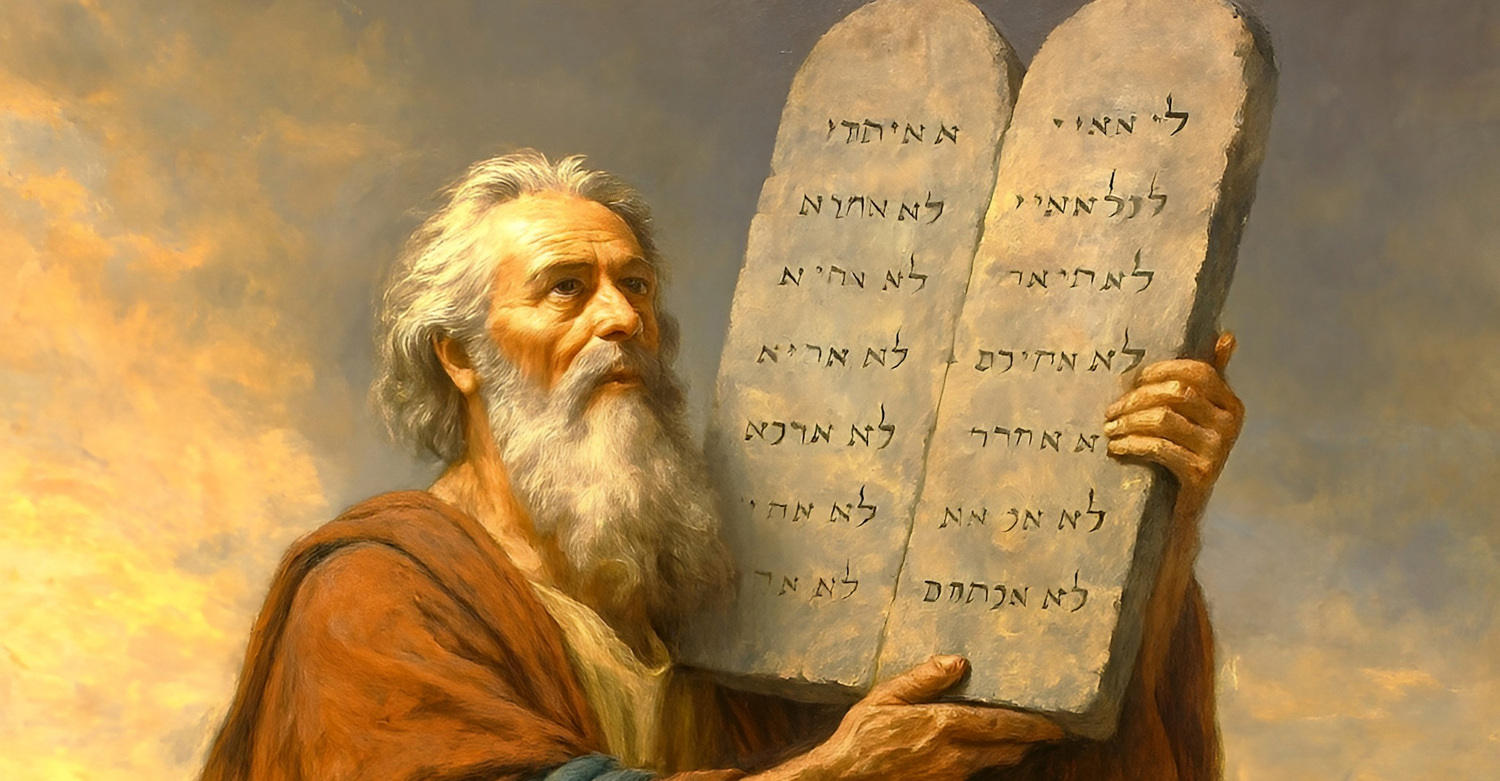
A little more than 3,500 years ago, Moses led the Israelites out of bondage in Egypt, across the Red Sea and into the Sinai desert. Three months later at Mount Sinai, God came down from heaven to make a new covenant with the Israelites. The core body of law included in that covenant was summarized in The Ten Commandments, also known as The Decalogue.
The Ten Commandments were first given verbally by God Himself, speaking directly from Mount Sinai to all the people of Israel. They were terrified by the encounter (Ex. 19-20). Later, Moses received The Ten Commandments on tablets of stone written “by the finger of God” (Ex. 24-31 and Ex. 31:18). There is a great deal more to the fascinating story of how The Ten Commandments were given by God and received by Israel. See Ex. 32 and Ex. 34, plus Deut. 10:1-5.
The Ten Commandments have survived intact for more than 3,500 years and are the standard for moral human conduct. These commandments strongly influenced legal tradition in the West and most of them, in one form or another, eventually found their way into U.S. law. Though unbelievers balk at this latter claim and frequently argue against it, contemporary moral and legal boundaries, such as prohibitions against theft and murder, originally came directly from The Creator. First they were given as The Natural Law, planted by God in the hearts of men and then literally written in stone by Him at Mount Sinai, thousands of years before the U.S. was founded.
Like The Lord’s Prayer, The Ten Commandments compress enormous meaning into few words. Complex contemporary laws concerning weights and measures, money, counterfeiting, and embezzlement, for example, all have roots in the four words of the Eighth Commandment: Thou shalt not steal. Though concise, we assert that because they encapsulate broad moral principles, The Ten Commandments provide much of the basic framework for our legal system.
It is good to memorize The Ten Commandments, for how can we adequately obey laws with which we are not familiar? We humbly present these brief statements of affirmation for contemplation and as an outline for further study:
- The first four of The Ten Commandments pertain to our relationship with God.
- The last six of The Ten Commandments pertain to our relationship with one another.
- I am the Lord thy God . . .Thou shalt have no other gods before me: There is only one God and He will not tolerate any pseudo-gods.
- The words, “before me” in The First Commandment do not merely prohibit gods “more important” than the one true God. They prohibit any other gods whatsoever.
- Thou shalt not make unto thee any graven image: We are not to make idols of any kind.
- Some argue that God permits statues, pictures, crucifixes and the like, as long as they are not worshipped. A safer course of action is to avoid such things altogether.
- Thou shalt not take the name of the Lord thy God in vain: The name of God is sacred and must never be used loosely or carelessly. It especially must never be used as a curse.
- Remember the Sabbath day, to keep it holy: God set aside one day of the week for rest, worship and the study of His Word.
- Since the time of Jesus, the day of worship is Sunday, which is the first day of the week. The day of worship is for our benefit.
- Unnecessary work should be avoided on Sunday, but necessary work, like caring for animals or the sick and dealing with emergencies like fires are exceptions.
- Honor thy father and thy mother: This commandment needs little explanation except to point out that it has particular importance for the very young, who must be obedient to their parents, and to adult children, who have a duty to help aged parents as needed and as circumstances permit.
- Thou shalt not kill: This means that we may not murder.
- The commandment against killing does not preclude self-defense that results in the necessary death of another or military service in legitimate defense of one’s country.
- Thou shalt not commit adultery: Sexual activity is reserved for the married. No sexual activity outside of marriage is permitted.
- Thou shalt not steal: We must not take that which is the property of another.
- Thou shalt not bear false witness: We must not lie. More broadly, we must not engage in deception, which is a specialty of Satan.
- There are many ways to deceive (bear false witness), including the withholding of true information.
- All forms of deception are prohibited by the commandment against bearing false witness.
- Thou shalt not covet: We are not to envy others for their possessions or anything else that is theirs, such as their job or their status in the community.
- Envy is a serious sin and a tool used very effectively by tyrannical, collectivist governments to divide and subjugate populations.
- The first four of The Ten Commandments give guidance on how God wishes to be worshipped.
- God wishes us to worship only Him and to do so sincerely (in spirit).
- God wishes us to worship Him without images or idols.
- God wishes us to worship Him with reverence, honoring His holy name.
- God wishes us to gather in formal worship on every Sabbath.
- The Ten Commandments are simple in principle, but sometimes difficult in application.
- There are unusual circumstances under which God will allow us to deceive others to further righteous objectives.
- The Ten Commandments should be interpreted in their broadest sense. The commandment against killing, for example, prohibits wishing ill upon another and the commandment against adultery prohibits lust.